


If you look at most modern razors, it’s easy to assume they were designed to deliver the best possible shave. More blades. Moving parts. Flex. Pivot. Comfort strips. With each generation promising improvement.
But when you step back, a different pattern emerges.
Modern shaving wasn’t optimized for correctness.
It was optimized for forgiveness.
Forgiveness vs. Correctness.
In product design, forgiveness means a system that continues to function reasonably well even when it’s used poorly. Wrong angle. Too much pressure. Rushed technique. A forgiving system absorbs those mistakes instead of exposing them.
Correctness is different. A correct system doesn’t try to adapt to every mistake. It aims to eliminate the need for compensation altogether by controlling the underlying mechanics.
The modern shaving industry made a clear choice between these two philosophies — and it chose forgiveness.
Forgiveness lowers the learning curve and increases adoption.
But forgiveness comes with a cost.
Why forgiveness scales.
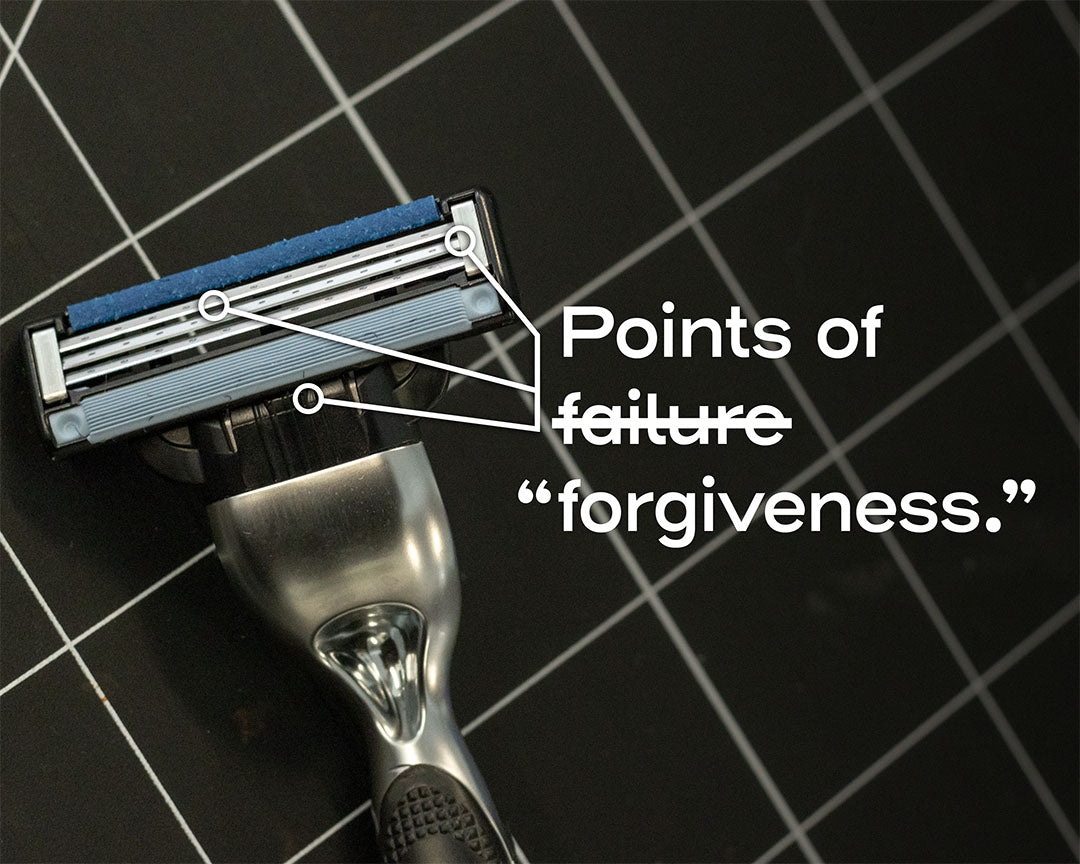
Cartridge razors are designed for universality. They assume no learning, no patience, and no consistency. To accommodate that, they rely on pivots, springs, floating blades, and flexible heads.
These features aren’t accidental. They reduce the risk of obvious cuts. They make shaving feel safer. They allow someone to drag a razor across their face at almost any angle and still get an acceptable result.
From a mass-market perspective, this is rational design. Forgiveness lowers the learning curve and increases adoption.
But forgiveness comes with a cost.
The mechanical tradeoff.
When blades are allowed to move, the cutting edge is no longer held at a stable angle. Under load — hair resistance combined with user-applied pressure — the blade deflects. That deflection changes the cutting angle mid-stroke.
The result is inconsistency.
Inconsistent cutting leads to tugging. Tugging leads users to apply more pressure. Increased pressure stabilizes the system temporarily, but it also drives the blades harder into the skin.
This chain matters:
Blade instability → inconsistent cutting → increased pressure → friction and skin stress.
Most people never see this chain. They only feel the outcome.
How forgiveness trains behaviour.
Because the system appears to work when pressure is added, users learn to press harder. Over time, that becomes a habit.
Irritation doesn’t feel like a design problem. It feels like a personal one. So people adapt instead of questioning the tool. They buy “sensitive skin” cartridges. They add gels and balms. They develop rituals and rules to manage outcomes that feel inevitable.
Shaving becomes something to endure rather than something to understand. This is how a design decision quietly reshapes behaviour.
Why correctness is harder to scale
Correctness demands something different.
A correct shaving system holds the blade rigidly. It fixes the cutting angle deliberately. It assumes that once the mechanics are right, light pressure is sufficient.
Correctness reduces the need for workarounds because there is nothing to compensate for.
But correctness doesn’t scale as easily. It requires the user to unlearn habits trained by forgiving systems. It assumes a willingness to understand one simple principle rather than rely on adaptation.
That makes it a poor fit for the mass market and a perfect fit for a different kind of customer.
When you design for everyone, you almost always trade away precision.
Why the industry made its choice.
The shaving industry didn’t ignore correctness by accident. It deprioritized it because forgiveness scales better. It reduces complaints. It minimizes liability. It supports a business model built on interchangeable cartridges and incremental feature changes.
Correctness, by contrast, rewards depth over convenience and understanding over immediacy.
When you design for everyone, you almost always trade away precision.
Why this tradeoff is finally being questioned.
Across many categories, people are starting to recognize a pattern: systems designed for mass appeal often normalize decline. They don’t fail loudly. They fail slowly.
Shaving irritation is one of those slow failures.
Once you understand the difference between forgiveness and correctness, it becomes difficult to accept irritation as “just the way it is.” The problem stops feeling personal. It starts looking structural.
That realization doesn’t sell a product.
It restores agency.
And once someone sees shaving as a design problem rather than a skin problem, the path forward becomes obvious.
Design Truth: Forgiveness vs. Correctness.
Modern razors are designed to be forgiving, not correct.
Forgiving systems adapt to poor angles, heavy pressure, and rushed technique by allowing blades to move. This makes shaving easier to start but mechanically inconsistent.
That inconsistency leads to tugging.
Tugging leads users to apply more pressure.
Pressure increases friction and skin stress.
Over time, irritation becomes normalized as a personal issue rather than recognized as a design tradeoff.
A correct shaving system does the opposite.
It holds the blade stable, fixes the cutting angle, and eliminates the need for compensation.
When the mechanics are correct, light pressure works — and irritation stops being something you manage and starts being something you avoid entirely.


5 reasons a Henson Razor makes a great gift (for the person who has everything)